Showing posts with label 1994. Show all posts

Sunday, August 31, 2025

You Can't Scare Me!: Goosebumps Classics, Book 17

You Can't Scare Me!: Goosebumps Classics, Book 17 by R.L. Stine

A girl is not scared of anything. She holds bees and other animals that cause other people to scream. Other kids try to find something that would scare her. Everything they try ends up backfiring. Finally after hearing that she believes in monster, they hatch a plan to have some older kids act as "mud monsters" to scare the girl. At night they all gather to watch the girl as they see some mud monsters approach. Then the older kids show up. When everyone realizes they are real mud monsters instead of the actors they all scream in horror. The book is fairly grounded in reality until the very end when it takes the supernatural twist.


Sunday, August 24, 2025

I Want a Pony (Pony Pals #1)

I Want a Pony (Pony Pals #1) by Jeanne Betancourt

A girl is bummed that she has to live with her grandma while her father travels abroad. She longs for the riding she used to do. She sees her neighbor has a pony and wishes she had one too. One day she sees a horse in distress and helps calm it and get the vet. After some challenges, she gets approval from the prime pony user (who is at boarding school) to take care of the pony. This makes her very happy. The story is simple, but has enough drama to keep it interesting. 

Saturday, July 19, 2025

Magic Tree House Books 1-8

Magic Tree House Books 1-8 by Mary Pope Osborne

Jack and Annie stumble across a magic tree house near their home in Pennsylvania. There are books there. When they look at a book and wish they end up in the place shown. They need the book of their home to go back. They go on some adventures and see they are accompanied by some animals. These often help them, and may be people in disguise. They discover that this is a set up form Morgan Le Fay from King Arthur time. She was a librarian with many books and they are able to help her escape from a curse. The books have some charm, but start to get old when read together.

1. Dinosaurs Before Dark - they see animals including a TRex

2. The Knight at Dawn - they go to the time of knights with 40 pound helmets

3.  Mummies in the Morning - they explore mummies and get lost in false passages in a tomb

4. Pirates Past Noon - they help pirates read a map to find treasure. They leave before getting the treasure due to a storm

5. Night of the Ninjas - they see boy and girl ninjas

6. Afternoon on the Amazon - in the amazon, they need to watch out for dangerous animals

7. Sunset of the Sabertooth - back in the time of sbertooth tigers

8. Midnight on the Moon - a future trip to a moon man before they finally free Morgan Le Fey

Friday, July 18, 2025

Blackberry Surprise (Walt Disney's Winnie the Pooh and his Friends)

Blackberry Surprise (Walt Disney's Winnie the Pooh and his Friends) based on stories by A. A. Milne, illustrated by Atelfer Philippe Harchy

This is a short derivative Winnie the Pooh book. It is always a bit suspicious when a book is credited to an author that died decades before.

Monday, June 23, 2025

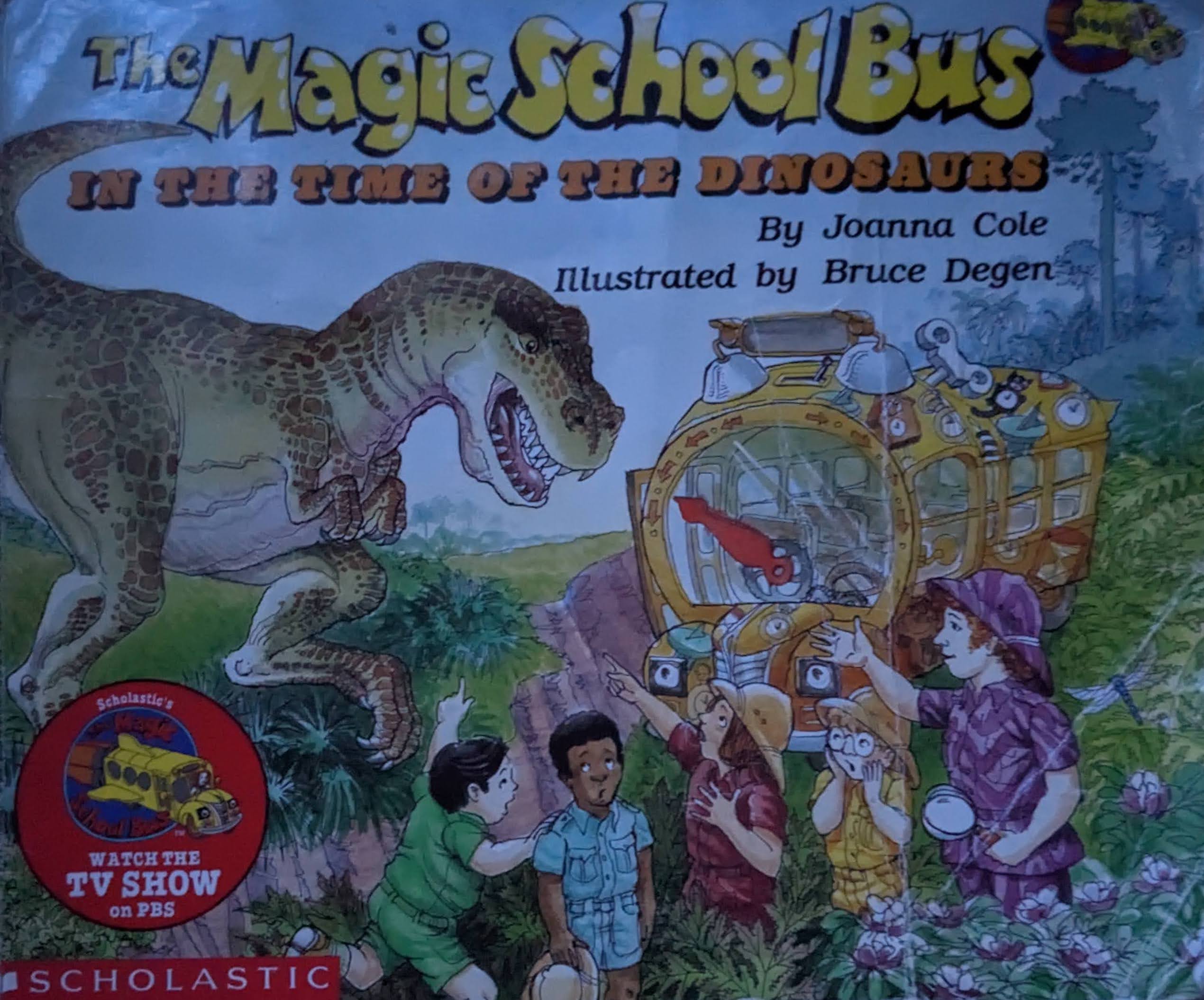
The Magic School Bus in the Time of the Dinosaurs

The Magic School Bus in the Time of the Dinosaurs by Joanna Cole, illustrated by Bruce Degen

The original Magic School Bus books have a nice charm to them. The pages have a story that can be read along with a large number of additional written and illustrated details. In this one, the class goes to visit a dinosaur dig site. Then they travel back in time. They accidentally go too far, and end up seeing what the site looked like in various points in time. Finally they see where the maiasaura eggs are at the "end" of the dinosaur times. When they return to the present they are able to tell the excavation crew where to look. Then they return to school for parent day. 


Sunday, June 22, 2025

Junie B. Jones Collection, Books 1-4

 Junie B. Jones Collection, Books 1-4 by Barbara Park

The books in this collection:

#1: Junie B. Jones and the Stupid Smelly Bus:

#2: Junie B. Jones and a Little Monkey Business:

#3: Junie B. Jones and Her Big Fat Mouth

#4: Junie B. Jones and Some Sneaky Peeky Spying

Junie B. Jones is an opinionated young girl who is starting kindergarten. In the books she learns that things are a bit different when you start kindergarten. She interprets things a bit too literally. One day she really needs to go to the bathroom. It is an "emergency", so she pulls the fire alarm. When she gets a new baby brother, she hears grandma call him a cute little monkey and assumes that her brother really is a monkey - and has classmates pay her for the privilege of seeing the monkey brother. She also learns to not jump to conclusions. She sees her teacher eat a grape and assume she is a criminal that will go to jail. She tried to hide the secret, but accidentally blurts it out. Junie B. can be funny, but does get annoying.

Tuesday, April 29, 2025

Abe Lincoln's Hat

Abe Lincoln's Hat by Martha Brenner (Author), Donald Cook (Illustrator)

Abe Lincoln was a fun-loving, friendly man. However, he was forgetful. He would often put important papers in his hat so that he would not forget them. This book tells about this as well as other important parts of Lincoln's life. The focus is on his early life. The presidency, civil war and assassination hardly make an appearance. Most of the time is spent describing the lawyer in Illinois. He helped set a man free by debunking witness testimony since there was no moon bright the night of the crime. He helped to free slaves in "free" Illinois. He worked hard to support others and his principles. The book is an easy read that humanizes Lincoln.

Sunday, March 30, 2025

The Three Little Kittens

The Three Little Kittens by Tracey Moroney

This board book has a short, simple telling of the three little kittens nursery rhyme with some anthropomorphic kittens. Nothing awful, but nothing very memorable either.

Tuesday, March 25, 2025

Sophie's World: A Novel About the History of Philosophy

Sophie's World: A Novel About the History of Philosophy by Jostein Gaarder, translated by Paulette Møller

Sophie is a Norwegian girl who gets mysterious messages from somebody providing information about philosophy. She loves the opportunity to learn and explore, starting from the big questions of what existence is. There is another girl and a father working as a UN observer in the middle east. At times it goes to the supernatural with them doing things such as going back to view the ancient philosophers. It is an interesting exploration of philosophy and some of the rational and scientific-based influences. It felt that it went on for a little too long as the story got a bit "weird".

Sunday, March 02, 2025

Clifford the Firehouse Dog

Clifford the Firehouse Dog by Norman Bridwell

Clifford goes to the city to visit his brother Nero who works as a firehouse dog. Clifford is able to join the fireman as the fight a fire, using his size to help out. It is a straightforward Clifford book.

Tuesday, February 18, 2025

Baby Jesus Is Born - Arch Books

Baby Jesus Is Born - Arch Books by Gloria A. Truitt, illustrated by Kathy Mitter

This is an illustrated, rhyming version of Luke 2 for children. The rhyming seems a bit forced - perhaps some better rhythm would help. The pictures are ok. I'd like to think there are better Nativity books out there.

Monday, February 03, 2025

Sources of the River

Sources of the River: Tracking David Thompson Across Western North America by Jack Nisbet

David Thompson explored the land of the Columbia River and the Pacific Northwest for the British business interests. However, he is not well known in history. This book intersperses the author's visits to the modern northwest, with the exploration stories of the Thompson. It seemed like it should have been interesting than it was.

Monday, January 27, 2025

Amber Brown Collection I: Amber Brown is Not a Crayon; You Can't Eat Your Chicken Pox, Amber Brown; Amber Brown Goes Fourth

Amber Brown Collection I: Amber Brown is Not a Crayon; You Can't Eat Your Chicken Pox, Amber Brown; Amber Brown Goes Fourth by Paula Danziger

The three first Amber Brown books are in this audiobook collection. Each book is only about an hour in (un-sped-up) length. The books are a little bit more serious than I was expecting, but has a bit of humor. They deal with a quirky child gradually adapting to challenges in life.

Amber Brown is Not a Crayon

Amber Brown has a name that is a color. She in third grade in New Jersey. Her parents have separated and her dad now works in France. Her best friend Justin is going to move. He gets busy with moving to Alabama and it makes it hard on her.

You Can't Eat Your Chicken Pox, Amber Brown

Amber's third grade year ends. She learns her mom will be dating another guy. She has plans to go to England with her aunt and France to see her dad. However, she gets the chicken pox while in England. There is some conflict with adults not trusting each other.


Amber Brown Goes Fourth

Amber Brown goes into fourth grade. She finally gets a new friend. However, it was not easy. She had to first adjust to the new friend not being the same as her old friend.


Saturday, January 04, 2025

New Visions for Metropolitan America

New Visions for Metropolitan America by Anthony Downs

The car-centric low-density suburban pattern has dominated American development since the end of World War II. New suburbs have autonomy and encourage comercial, retail and housing development within their boundaries. They enforce ever stricter zoning and building codes to provide higher-quality housing. The poor are priced out of new suburbs and find themselves confined to older inner-city developments of lower quality. Eventually, some of the more well-to-do inner-city residents can migrate to older inner-ring suburbs that have fallen out of favor, however, most remain confined to to the inner ghetto. The inner city often ends up a high poverty, high crime area, with few working class jobs, yet it still supports regional immenties. The disparate pattern of development also results in increased car-centric commute times.

The solutions proposed in the book seek to improve the condition of everyone in the metropolitan area. Regional bodies and regulation will help everyone in the metropolitan area. Increasing density will allow for more affordable housing and reduced commute times. Greenbelts and growth boundaries will help improve the conditions of everyone. Getting there is the challenge. People like having responsive, small scale governments. Government officials like to showcase short term improvements. There is little patience for improvements that take a long time to show results in the long term, especially if they involve sacrifices.

The author has identified many of the challenges to improve the quality of metropolitan areas. Getting a workable solution is a challenge. Even the best set plans can be subverted by inertia and vested interests. It is interesting that in passing he mentions societies decision to turn the mentally ill out in society. That, together with drug epidemics and high housing costs has produced a homeless crisis. That has attracted immediate concern. Alas, it seems most people are eager to throw lots of money at housing authorities and hope it goes away. Nobody wants to address the root causes (especially the housing authorities). It seems society has tried to opt for the "most expensive" solution for housing, and fumbling with it.  

On transportation, we have a mixed result. We are still building far-flung suburbs and spending money to expand roads. However, we are spending billions of dollars on new public transportation infrastructure. It looks good and produces plenty of pork, but not necessarily improvements. In Seattle, Sound Transit is a government agency responsible for light rail and longer-distance buses. Most of the board is made up primarily of local officials. There is also incredible attention to geographical equity. However, the agency is required to get local approval for all work. This allows local suburbs to extract demands from the transit agency. The transit agency has become a money pot that has provided road improvements, parking garages and other car-centric infrastructure. Local governments have specifically fought rail alignments near high density areas due to perceived impacts. Instead, much of the rail line has been near suburban freeways with limited density (or even potential density.) It may be succeeding now. Is this the first step in the improved metropolitan development, or will this be the cautionary case that will prevent the positive long-term goal?

Thursday, November 21, 2024

The Day After Tomorrow

The Day After Tomorrow by Allan Folsom

The book starts with a doctor seeing a face in a coffee shop, and ends with a famous face. In between there are a whole bunch of murders and many close calls. The novel is long and engrossing. There are few major plot twists. Most of it is just a gradual unraveling of the story. You know the major characters will survive, while the minor ones seem to get killed off. The case gradually unravels. Some parts seem a little odd. Why would an operation that is so carefully carried out leave severed heads where they can be discovered? They seem to be so meticulous about destroying other evidence, why not the key ones?  (Or perhaps was this just a part of the doctor to help draw people to the trail.)  Having Nazis as bad guys seems to have gone out of vogue these days, but right after the end of the cold war, it seems a logical option. It does seem amazing that they could go through decades of killings and not get caught, but perhaps this is just like Russians "accidentally" jumping out of windows. If they really want to revive Hitler via attaching a new body, they will go through anything.

Monday, November 11, 2024

Understanding Comics: The Invisible Art

Understanding Comics: The Invisible Art by Scott McCloud

What are comics and how do they work? Defining comics becomes somewhat challenging. The author uses "sequential art". This covers comic books and most comic strips (but leaves out "single frame" comics.) It also goes on to include cave paintings and various other art forms.

Comics have a number of unique aspects that help to tell a story. They are a form that actively combines pictures and words to tell a story. This has contributed to their reputation of "lower class" work, in part due to the differing evolution of pictures and books. Comics have also produced innovations to explore time and emotions. Abstraction can be used to bring out or hide details as well as help be relate to certain parts of comics. There is a create deal of complexity in what seems to be a "simple" art form.

Saturday, December 30, 2023

Jews, God, and History

Jews, God, and History by Max I. Dimont

This book shows the history of the Jews in context of the greater world. The Jews developed a strong culture, but never developed a lasting civilization. This may be part of the reason why they have survived so long. They have been able to live in many civilizations and take active roles. There were backgrounds in Jewish sects that would later be the roots of Christianity. Similar Jewish influences can be found in Islam. The religion has changed and adapted with the times, while keeping many constants and a strong affinity. 

Saturday, January 07, 2023

The Hot Zone: A Terrifying True Story

A resident in Africa visited a cave. A week later he started to get sick. By the time he got to the hospital his internal organs were falling apart in his body. He did not live long. The doctor that attempted to help him also go sick, but managed to survive.

Marburg and Ebola are related diseases that have extreme mortality in humans and other primates. This book focuses on the Ebola outbreak that started in a monkey facility in Northern Virginia. It was a while before they realized that they were dying of Ebola, but by then some people were infected. Luckily this variant was not fatal in humans and was able to be controlled. The story is a well written thriller that provides scientific detail that flows well with the story.

Saturday, February 13, 2021

The Red Queen: Sex and the Evolution of Human Nature

The Red Queen hypothesis comes from the character in Lewis Carrol's Through the Looking Glass who is always running in order to keep in the same place. Sexual selection must be used as part of the mechanism to continually evolve and adapt in order to stave off extinction. The book starts by asking "why sex?" It seems a very inefficient way to pass on genes. After all, why not just clone oneself to pass on all genes? There are many theories. The "change" is a key benefit. There are chances to clean up "mistakes" or introduce "new mistakes". It also encourages social behaviors. Different animals have adapted in various ways due to their mating patterns. Sex selection also happens in various manners (sometimes based on things such as temperature.) Humans are rather unique in not knowing the precise time of fertility and not producing off-spring that are "done" yet. (The "big brains" need to fit through the small birth canal.) People seem to have an in-built incest restriction against mating with people we have grown up with. Other mating rules have differed across cultures. Monogamy has become a common way to ensure the child has two parents to help with raising. Polygamy may benefit a few men at the top of the hierarchy, but in general it benefits women who now have greater access to the alphas. Men seek traits in women that allow for the production of more offspring (such as youth.)

There are many interesting theories put out and discarded in the book. The book even ends admitting that much of what is written will be proven wrong. Humans have adapted quite well to dominate the current world. Will we continue to do so?

Monday, July 15, 2019

Why Marriages Succeed or Fail: And How You Can Make Yours Last

John Gottman did an extensive study on couples and how their relationships succeed or fail. The majority of marriages fail. However there are a number of signs of success. One key is to have 5 times as many "good" interactions as bad. A bad sign is when even initial memories of the marriage are recalled negatively.
He identified a few different types of personalities and their interactions. Some are very communicative. Some avoid conflict, while others appear to thrive on it. All styles can succeed with the proper effort. (Though mismatching styles can be challenging.
Some common problems seen include stonewalling. Often one person (often the man) will be so upset that they will not give way or communicate. Other problems include (usually erroneously) inferring negative thoughts or motives to the other party. The key to resolving issues is often as simple as being open with listening and communicating. People will often communicate fine with strangers, and then get into a rage with their spouse. Just because we know them well does not mean they don't have needs to be validated and respected.