Showing posts with label police. Show all posts

Tuesday, October 08, 2024

Strange Things Happen: A Life with The Police, Polo, and Pygmies

Strange Things Happen: A Life with The Police, Polo, and Pygmies by Stewart Copeland

Stewart Copeland was the drummer in the influential band The Police. He was an American in a British band who loved improvisation. He also head a reputation for not getting along well with bassist/singer Sting. The first part of the book covers some of his adventures. He played polo and beat British royalty. He found himself chained to a bench in Africa. He also was able to defend himself from a lion attack by playing his drums loudly. He also wrote numerous film scores and even composed an opera.

The end of the book focuses on the final tour with the Police. It is quite easy to see why they had so much conflict. There are a couple of strong personalities that liked to make music his way.  They seemed to get along personally, but would be at total loggerheads when it came to making music. There was a lot of extreme self-criticism. The conflict may have helped make the music better, but made the band unsustainable in the long term.


Monday, June 22, 2020

Rise of the Warrior Cop: The Militarization of America’s Police Forces

Municipal Police are a relative modern innovation. While police did exist in ancient Rome, they fell out of favor in much of the world. They were not really established until decades after the founding of the United States. Prior to that, communities were mostly homogeneous and would carry out their own discipline. Police were needed only after the rise of larger, less homogeneous cities. Different approaches were used for police initially. Some cities made them very local patronage jobs. This had advantages in that they knew the community. However, it also was rife with corruption and discriminated against non-community members. The opposite extreme was a distant non-resident professionalized force. This eliminated the corruption and seemed to provide equal service. However, the police had little "skin in the game" and did not necessarily align with community needs.
An important point of police process is the "castle doctrine". A person's home is a castle and cannot be broached except under extreme circumstances. The third amendment to the constitution alludes to this. This concept was gradually broached as police powers expanded.
Slavery and reconstruction were both used to expand police powers. Ironically, laws used to capture fugitive slaves were later used to enforce rights of freed blacks in reconstruction. The rule of unintended consequences does seem to regularly play a roll in law enforcement.
The 1960s and the war on drugs saw a huge increase in police militarization. SWAT teams were created to help respond to extreme situations. On large police forces, there was often some justification for these teams to respond to some extreme situations. On smaller police forces, these teams were often forced to justify their uses. The police would use the SWAT team in places where it is not needed, simply because they had a team. No-knock search warrants also became favored by SWAT teams in drug raids. Even the "knock" warrant usually was followed quickly by break in, with the fear that drug evidence may be flushed down the toilet. SWAT team members often loved the thrill of the break in. Civil forfeiture laws further encouraged police to go after drugs in order to make money. The police were able to make money and have fun, but did little to help stop the drug trade. There was also collateral damage, with many cases of cops hitting the wrong house or killing innocent people.
The book does a great deal to support many of the "defund the police" arguments. However, there are many complexities that need to be explored. Especially with regards to drug police, there are federal laws that pre-empt some of the state laws. There are some cases where the militarized force is needed. (After all, it was an inability to properly respond to Austin sniper-shootings that helped lead to militarization.) It is a tough challenge.
The book is highly relevant to the current political debate. However, it also identifies some of the political challenges. The "party out of control" often tends to be the one against militarization of police. Thus, democrats seem to be the "saviors" today. However, Biden's name comes up repeatedly in this book as one of the key sponsors of legislation to increase the scope and militarization of police. If he becomes president will it just shift the police to the "left-wing enforces" and leave are country further divided?

Monday, May 25, 2020

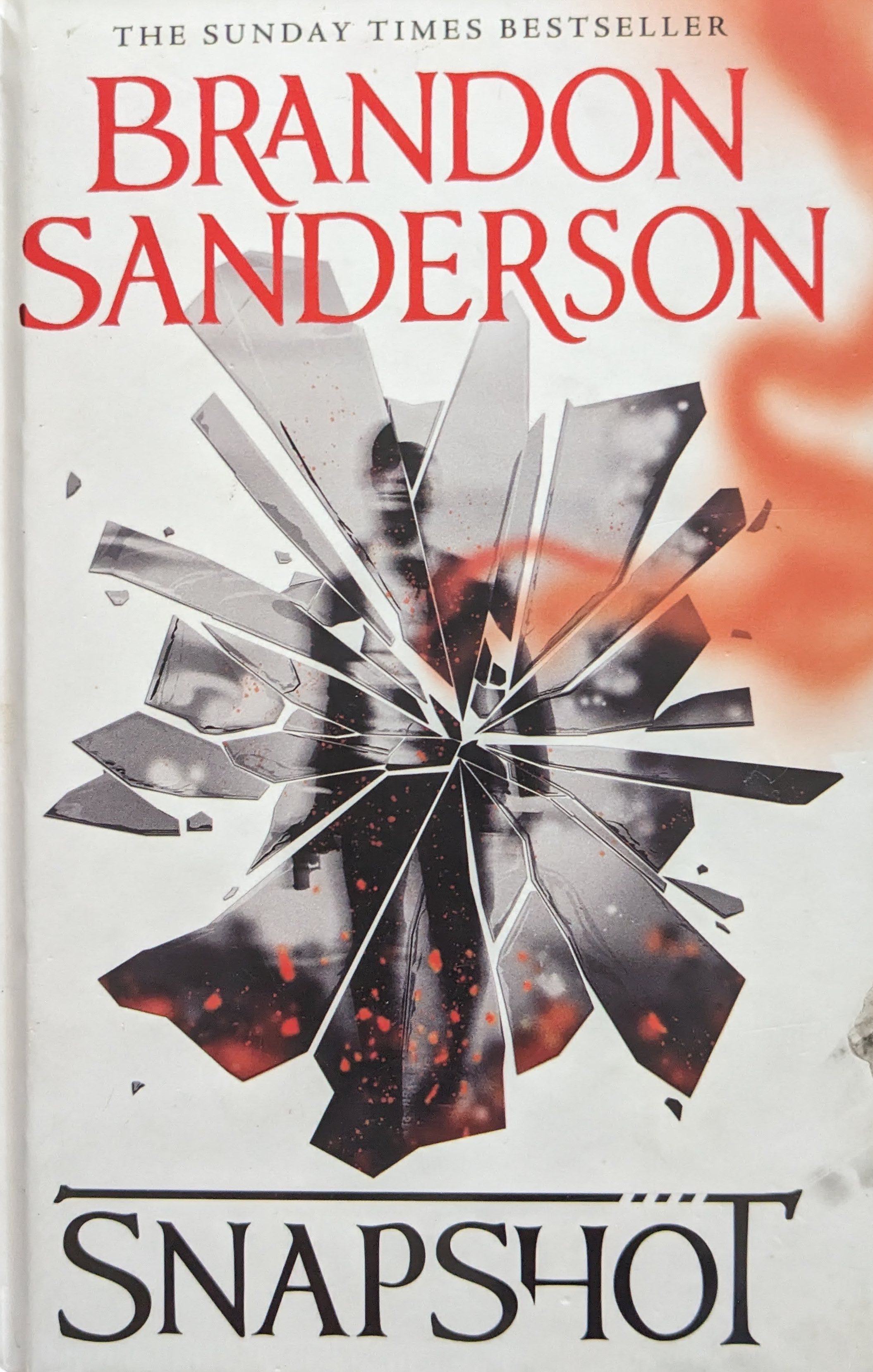
Snapshot

Snapshot by Brandon Sanderson

A Snapshot is a "replay" of a past point in time. A couple of "real detectives" can go back into the snapshot to observe what happened. However, since they are active participants, they can create "deviations" from the actual events. The snapshot computers provide a fully accurate replay of a small region. They also are able to calculate the degree of "change" that occurred in the snapshot. However, only "real people" in the snapshot can observe the details. The real people can also suffer and die within the snapshot. They can't really bring anything out of the snapshot. (Though they may be able to swallow something.) There are also plenty of privacy concerns with Snapshots. They can only be explored under warrant. The snapshot detective positions are low prestige, and typically takes those with minimal other opportunities. In a Snapshot, however, they are near omnipotent. They can flash a "snapshot" badge which lets people know they are in a snapshot, causing interesting reactions.

The Snapshot story follows two partners who are on duty to try to hunt for a murder weapon. They are able to find that, and then are told to stay in a safe house while waiting to explore a domestic violence incident. However, rather than do that, they explore another case of a serial killer that seems to be working around snapshot detectives. They also take time to visit family including one detectives non-custodial child. Things take a few turns, and we also end up with a Snapshot in a Snapshot and a few murder cases being resolved.

The snapshot is an intriguing structure. The story explores a lot of the concerns and abuses. It is also set as a "one burst of technology" in the near term future. There is a great deal of opportunity to explore this technology in future work.

Wednesday, April 03, 2013

Sledge Hammer!

Sledge Hammer was a mid-80s television show that had low ratings and was constantly moved around the schedule. At the end of the first season, a nuclear bomb destroyed everybody. Yet, the series was somehow renewed for one more season.

It was ridiculously funny when it came out. While there are a few "current events" jokes in the series, most of the humor is just as funny today. Inspector Sledge Hammer is a violence loving cop who manages to catch the bad guys in spite of himself. The humor is primarily a mixture of "Pink Panther" style slapstick cock and deadpan ironic dialog.

A quick scan of Wikipedia shows the primary actors and creator were best known for their work on this series. (In spite of work on many other movies and TV shows, and even a marriage to Michael Chrichton.) The actors don't look like the 'perfect' TV actors. The sets and action are all "good enough", but not perfect. Its not B-move bad, but more of a comic book level of imperfection that adds to its charm.

The show centers around a cop with extreme violent tendencies. However, it manages to do this with very little violence. In spite of a fascination with a gun, we never see Sledge kill anybody. The restrainment allows it to be truly funny. It often parodies other movies or characters (one episode manages to parody both The Godfather and Witness.) The humor appeals to both kids and adults alike.

Tuesday, January 29, 2013

Mr. T on the loose

A student apparently thought he saw Mr. T at Cupertino Middle School. The entire school went on lockdown, because obviously, who would want 80s TV stars near a school? He might even encourage them to, I dunno, exercise or something.

Unfortunately, it looks like it was all a hoax. A student had just fabricated the whole story of a "black guy with a mohawk carrying a gun near the school. You'd think they would do a little fact checking. But, after the Connecticut shooting, I guess the schools are in full paranoid mode. But, would this even help? If there really were a guy with a gun near the school, couldn't he just unload his clips before the cops got there? Or if he didn't, could the police and him get in a shootout?

As for the fact checking. Well, did anybody else in the neighborhood notice him? In a mostly middle class Asian neighborhood, a black man with mohawk would stick out. And with a gun, holy black pants and a limp? Uh, this sounds like somebody was watching some 80s TV. But it does go to show the power that one kid can have. And